-
Episode 22 – ORCs, rings, and Galactic histories
In this episode, Payel and Nicole discuss what happens to the metallicity gradient of a satellite galaxy after it merges with its host, the existence of intermediate-age RR lyrae and radio rings, the possibility of determining the history of the inner Milky Way from radially migrated stars, and the possibility of finding more Einstein rings…
-
Episode 21 – Mercury, chemistry and quasi periodic eruptions
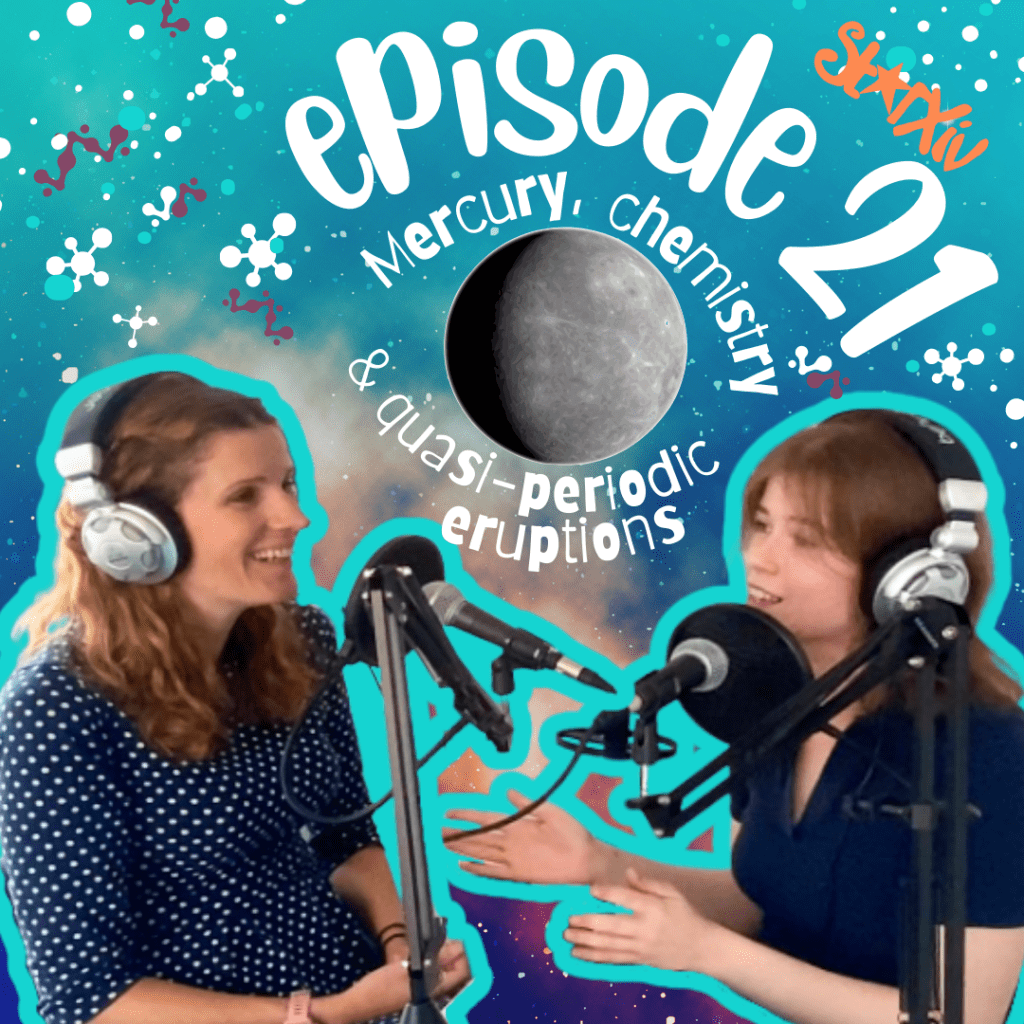
In this episode, Michelle and Nicole explore various astronomical topics, including merger debris around a galaxy, metal-mixing in early stars, quasi-periodic eruptions in Ansky, relic galaxies, Mercury’s magnetosphere, and second-generation stars in globular clusters. Tune in on Spotify, Apple Podcasts, or other platforms for more insights.
-
Episode 20 – Dark galaxies, black holes, star formation and life in the faintest galaxies?
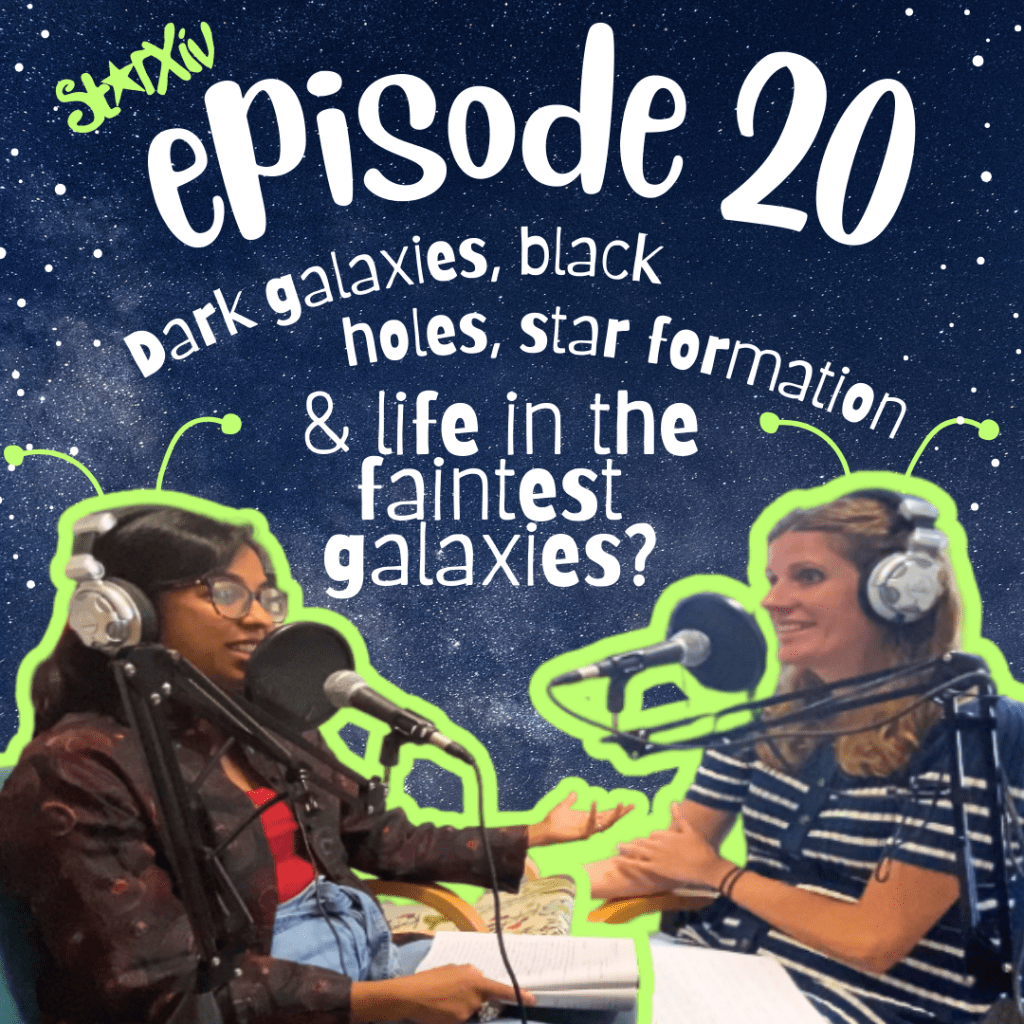
In this episode of StarXiv, Michelle and Payel discuss black holes, feedback-free star formation, dark galaxies, runaway dwarf galaxies, and exploring the potential for life in the faintest galaxies. Accessible on major podcast platforms.
-
Episode 19 – Peering into the Local Universe, distant black holes, forming planets and alien signatures
In this episode, Michelle and Payel explore the chemistry of nearby M-dwarf stars and the formation of giant planets at significant distances from their hosts. They discuss supermassive black holes and the search for alien technosignatures. Relevant research papers discussed are also highlighted for further reading.
-
Episode 18 – disks, disks and more disks!
In this episode, Michelle and Nicole dissect 5 papers, and accidentally find a common theme: disks! Whether in low mass galaxies, giant low surface brightness galaxies, the rotation curves of spirals or the natal environment of planetary systems, disks really are all around us. They also discuss the differences in chemistries between globular clusters that…
-
Episode 17 – detecting dark matter, unusual black holes and speedy stars

In this episode, Michelle and Payel explore the detection of a starless dark matter subhalo, the characteristics of fast, puffy white dwarfs, and the formation and merging processes of black holes. They also discuss star clusters in the Sparkler galaxy, referencing relevant research papers for further insight.
-
Episode 16 – interstellar visitors, molten planets and faint, dark galaxies
In this episode, Michelle and Payel squash in more papers than ever, as Michelle delves into a flurry of papers about new newly discovered interstellar comet: 3I/ATLAS. They also discuss what sets the metallicities of the faintest galaxies, how nitrogen enrichment relates to gas density, the molten properties of a new ultra-short period planets, and…
-
Episode 15 – Flare-inducing planets, avoiding catastrophe, and accreted star clusters
In this episode, Michelle and Payel delve into topics including long period pulsars, population III galaxies, and Galactic archaeology. They discuss noteworthy research on metal-free galaxies, stellar flares caused by close-in planets, and more. Listen on major podcast platforms and chech out the links to discussed papers.
-
Episode 14 – A cosmic owl, misaligned planetary systems, and the Milky Way as an outlier
In this episode, we had Payel and Nicole filling in for Michelle who’s away on holiday. Nicole is a PhD student, also at the University of Surrey Astrophysics research group. They discuss the direct detection of HI beyond the local universe, how the Milky Way seems unusually cold, a planetary system with two misaligned planets,…
-
Episode 13 – Missing Europium, Pluto’s craters, 43,000 Goblins and some Pop III stars
In this episode, Michelle and Payel discuss why dark matter halos have a Universal density profile, how to age-date Pluto’s surface with craters, delayed Pop III star formation, dwarf candidates in the UNIONS survey, a problem with Europium and whether Little Red Dots are really AGN. Listen below, on Spotify, Apple podcasts or wherever you…

The StarXiv
A podcast that delves into the newest astronomy papers from astro-ph on the arXiv
 The StarXiv